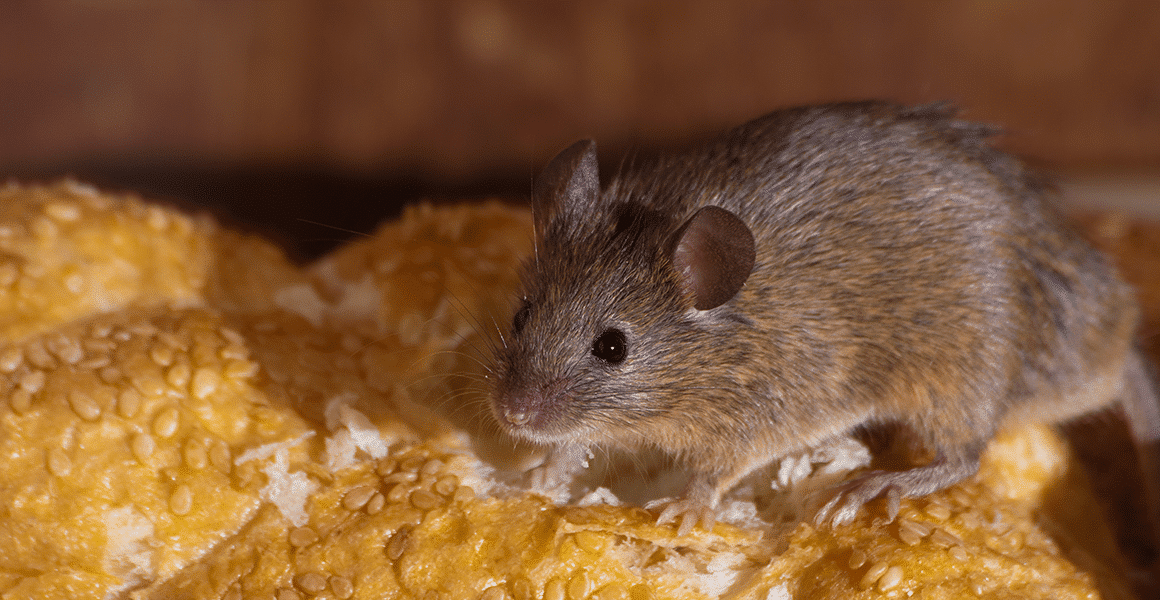
Vous avez remarqué la présence de grosses fourmis noires chez vous à Laval, Longueuil or in Montreal ? Attention : il pourrait s’agir de fourmis charpentières, des insectes capables de causer des dommages structurels importants.
In Greater Montreal, these pests are on the rise, particularly in wooded or wetland areas. Acting quickly with appropriate treatment is essential to effectively protect your property and avoid costly repairs.
This comprehensive guide, prepared by 911 Exterminator, explains the signs of an infestation, recommended extermination methods, average costs in 2026, and professional services available in your area.
Prevention, inspection, extermination, budget: find out how to eliminate carpenter ants from your home for good.
🐜 Need an exterminator today? Get your free quote quickly!

How can you identify a carpenter ant infestation in your home?
Key signs of infestation to watch out for
Visible presence of black or red ants
Carpenter ants are often mistaken for other species, but their larger size (6 to 12 mm) and their movement in single file are telltale signs. You will usually see them near woodwork, foundations, or in the kitchen.
Unusual noises coming from the walls
When the colony is well established, you may hear slight crackling or scratching noises in the walls, especially at night. These are the workers digging their galleries in the wood.
Sawdust (frass) and residue around baseboards
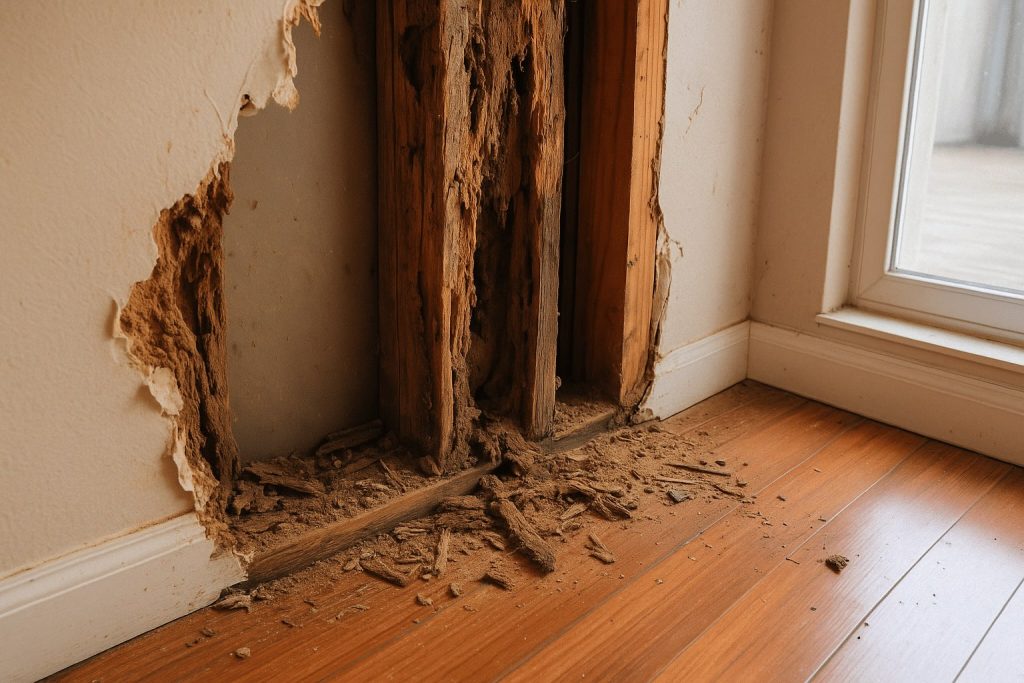
Unlike termites, which consume wood, these insects eject it. You'll notice small piles of fine sawdust, often accompanied by fragments of dead insects or wings.
Presence of wings near windows or doors
Winged reproductives (also called sexual reproduction) usually emerge in the spring. If you find fallen wings indoors, it's often a sign that a colony has already established itself in the house.
Differences between carpenter ants and termites
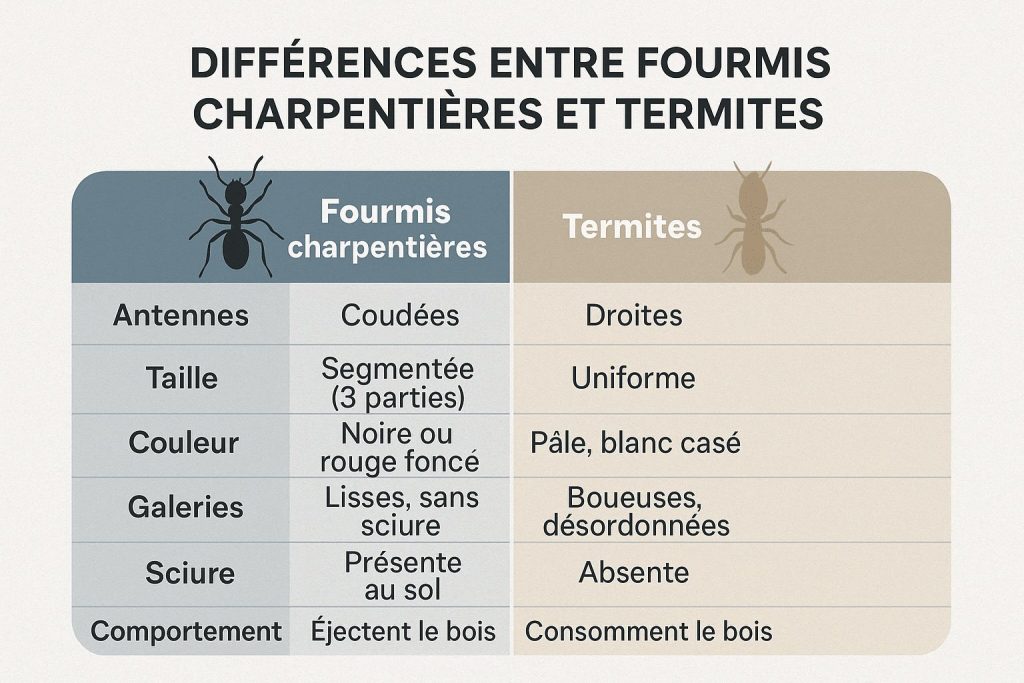
Distinctive physical features
- These ants have a well-defined segmented waist and angled antennae.
– Les termites, quant à eux, présentent une taille plus uniforme, des antennes droites et un corps plus pâle.
Wood damage: recognizing the differences
- The galleries dug by the ants are smooth, clean and free of sawdust.
- Termites leave behind a labyrinth-like hollowed-out wood with muddy residues.
To find out more about pest control treatments registered in Quebec, visit
Health Canada's official page on pest control.
Why are carpenter ants a major problem in Greater Montreal?
Areas most at risk in Greater Montreal (Laval, North Shore, South Shore)
Particularly hard-hit neighborhoods (wooded, damp, older residential areas)
Les fourmis charpentières s’installent principalement dans les quartiers à forte densité de végétation ou d’humidité. Sur la Rive-Nord, des secteurs comme Terrebonne, Mascouche ou Blainville sont régulièrement ciblés. Sur la Rive-Sud, on les retrouve fréquemment à Brossard, Longueuil, Saint-Hubert, and eastern Châteauguay. In Laval and several surrounding boroughs of Montreal, properties near parks, wooded areas, or bodies of water are also vulnerable.
Older houses, built before current insulation standards or having suffered water infiltration, provide ideal conditions for these pests. Poorly ventilated crawl spaces, uninsulated garages, and exposed wooden roof structures are all weak points.
What damage can they do to your home?
Frequent structural damage (frames, walls, insulation)
Unlike termites, which consume wood, the Carpenter ants digging it out to form a gallery network. They weaken load-bearing elements such as joists, half-timbering and interior walls. If they attack a damp roof structure, the damage can progress rapidly without any visible signs on the outside.
Ces galeries peuvent également atteindre l’isolation murale, créant des zones de condensation, de moisissure ou même d’instabilité thermique dans la maison. Lorsqu’elles s’installent près des circuits électriques, elles augmentent aussi les risques de court-circuit ou d’incendie.
Financial risks associated with untreated infestation
A neglected infestation lasting several months can lead to costly repairs. In addition to extermination fees, there are often costs associated with partial demolition, replacing affected structures, and hiring professionals (engineers, electricians, carpenters). In the most severe cases, the bill can exceed $10,000, not including the loss of property value upon resale.
How much will a carpenter ant exterminator cost in Greater Montreal in 2026?
Average price by type of treatment
One-time treatment (single intervention)
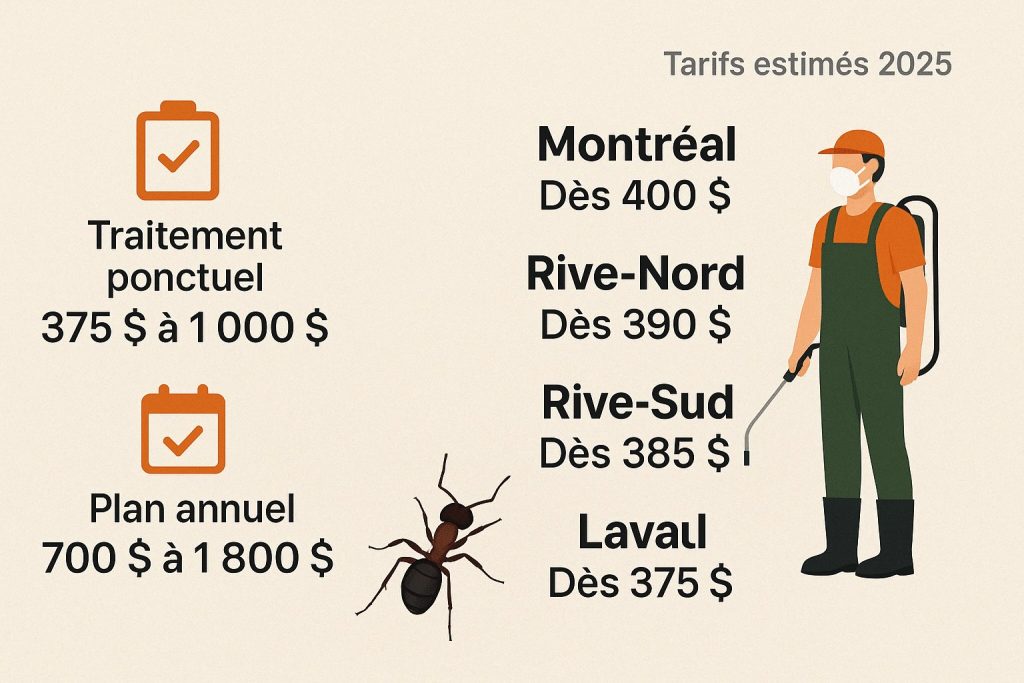
The cost of a one-time treatment against carpenter ants generally varies between $375 and $1000, depending on the severity of the infestation and the area to be treated.
Recurring treatments (annual plans, preventive monitoring)
For homes located in high-risk areas or with a history of infestation, annual packages with regular inspections and preventative treatments are often recommended. These packages typically cost between $700 and $1800 per year.
Comparative table of extermination rates by sector
| SECTOR | SPOT TREATMENT | ANNUAL PACKAGE (PREVENTION + FOLLOW-UP) |
|---|---|---|
| Montreal (city center) | 400 $ – 1 000 $ | 800 $ – 1 800 $ |
| North Shore (including Laval) | 375 $ – 980 $ | 750 $ – 1 750 $ |
| South Shore (including Longueuil, Brossard, Saint-Hubert) | 380 $ – 970 $ | 760 $ – 1 730 $ |
The prices shown are based on market observations in 2026. They may vary depending on the season, access to the infested area and the method chosen.
Factors influencing prices
- House size : the larger it is, the longer and more costly the treatment.
- Severity of infestation : A large colony with several nests requires more effort.
- Access to the nest : More complex treatment if the nests are in the walls or roof.
- Method type : ecological or thermal treatments can be more expensive.
- Season : Demand is highest in spring and autumn.
What are the best methods for effectively exterminating carpenter ants in 2026?
Recommended professional methods
Targeted chemical treatment (sprays, insecticide gels)
Exterminators typically use approved products applied directly to infested areas. Residual sprays target the tunnels, while insecticidal gels are placed at strategic entry points. These treatments have the advantage of acting quickly and limiting the spread of the colony.
Treatment with specialized baits and traps
Borax or hydramethylnon-based baits are effective when properly positioned. The workers carry the insecticide back to the queen, which allows the colony to be neutralized at the source. This type of intervention is often used in addition to chemical treatment or in more sensitive places such as kitchens.
Thermal method (heat treatment): advantages and limitations
Still relatively uncommon in Quebec, this technique involves heating wooden structures to over 50°C to eliminate ants. It is effective and environmentally friendly, but expensive. It requires specialized equipment and is not always suitable for occupied or poorly insulated homes.
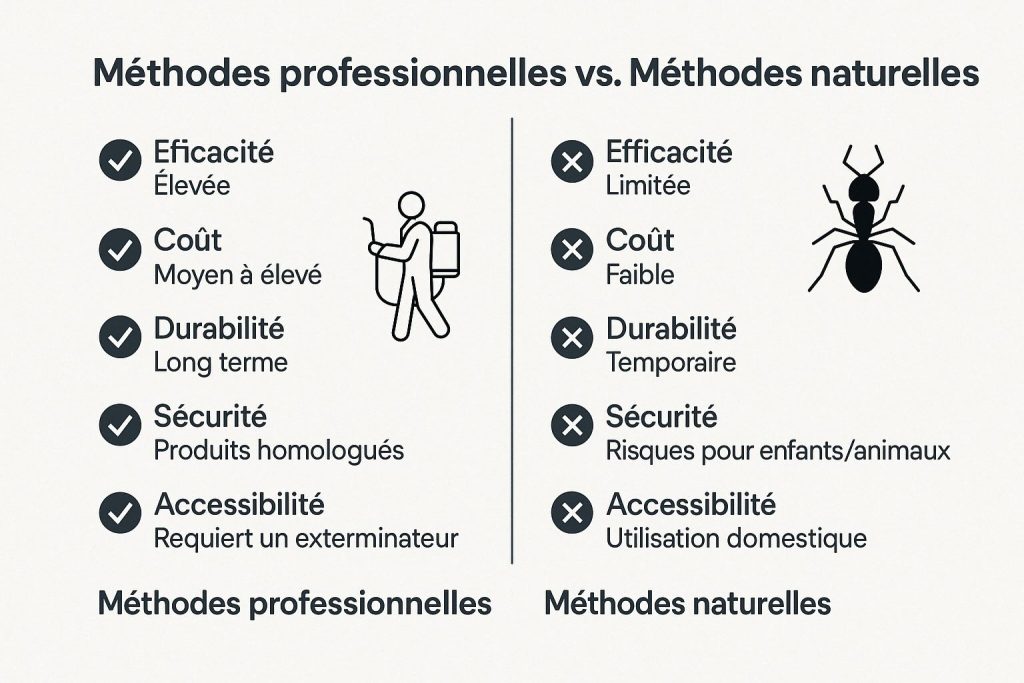
Natural and ecological methods: what are they really worth?
Effectiveness of home treatments (vinegar, essential oil, diatomaceous earth)
Some natural products can temporarily deter ants, such as white vinegar or essential oils (peppermint, citronella). Diatomaceous earth can work on small colonies visible on the surface. However, these solutions do not eliminate the queen or secondary nests.
Limits of natural methods to control carpenter ants
These approaches are rarely sufficient against an established colony. Carpenter ants burrow deep into walls and can create multiple satellite nests. Without a professional diagnosis, treatment is likely to be ineffective, or even counterproductive if the colony disperses.
Conclusion: For lasting and safe control, the intervention of a certified exterminator remains the most effective solution.
Procedure for professional carpenter ant control
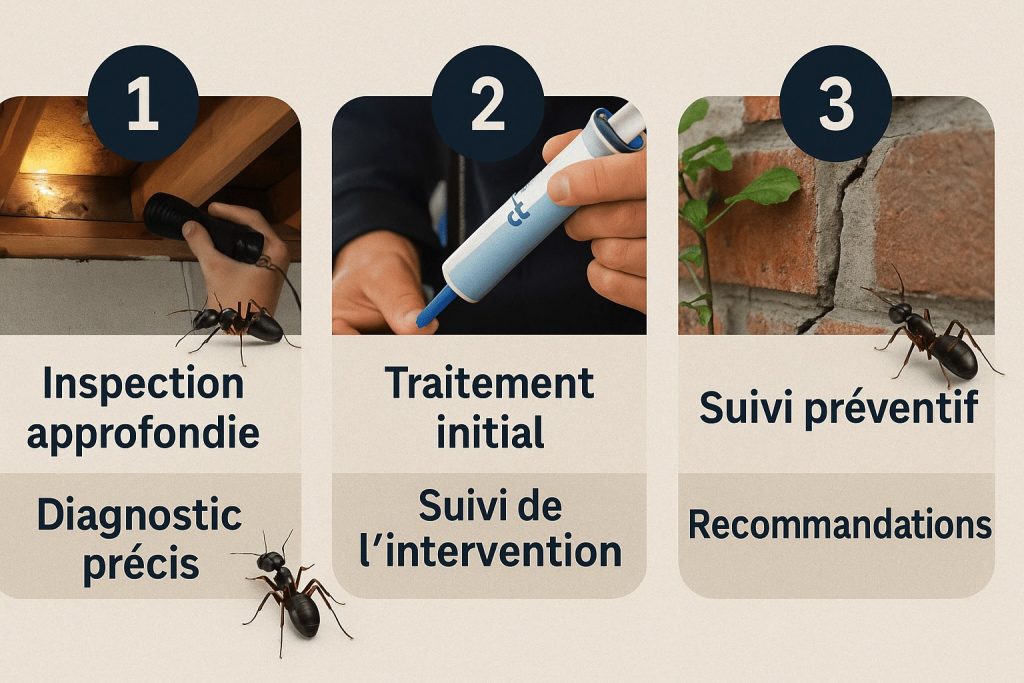
Step 1: Thorough inspection by the exterminator
Points checked during the inspection
The professional meticulously inspects the vulnerable areas of the house: woodwork, foundations, attics and crawl spaces. He looks for signs of activity such as sawdust, tunnels or the presence of insect wings.
The importance of accurate diagnosis
A precise diagnosis allows for the location of the main and satellite nests. This step is crucial for choosing the most effective intervention method.
Step 2: Initial treatment tailored to the infestation
Choice of products and techniques
Depending on the layout of the premises, the exterminator may apply insecticidal gel, localized spraying, or place specialized baits. The products used are approved by Health Canada and safe once dry.
Duration and follow-up of initial intervention
An average procedure lasts between 1 and 2 hours. A follow-up is usually scheduled 10 to 15 days later to check the effectiveness of the treatment.
Step 3: Preventive follow-up and post-treatment recommendations
Frequency of follow-up visits
In severe cases or at high risk of reinfestation, quarterly or semi-annual monitoring may be recommended to prevent the return of a colony.
Do-it-yourself measures to prevent the return of ants
It is advisable to :
- Repairing water infiltration quickly.
- Pruning branches in contact with the house.
- Sealing cracks around foundations and windows.
- Avoid storing wood against exterior walls.
Prevention: how to protect your home from carpenter ants?
Simple preventive measures to be applied today
Maintenance of outdoor areas (dead wood, dampness, shrubs)
Carpenter ants often nest near homes where vegetation is dense and humidity is persistent. To limit their presence, eliminate any source of excessive moisture, trim shrubs growing against walls, and avoid stacking firewood against the house.
Waterproofing and regular structural maintenance of your home
Regularly inspect foundations, window frames, and attics. Seal cracks, replace damaged materials, and ensure good ventilation in crawl spaces and basements to limit entry points.
You can consult the Health Canada's guide to carpenter ant prevention to learn more about these best practices.
Frequent mistakes to avoid attracting these pests
Firewood storage
Store your firewood at least three meters away from the house and raised off the ground. Damp wood attracts colonies and makes it easier for them to get inside.
Poor garden and gutter maintenance practices
Clogged gutters create damp areas, as do piles of leaves on the ground. Inadequate garden maintenance encourages nesting, especially near wooden foundations.
Testimonials and user reviews of carpenter ant exterminators in Quebec
Concrete examples of successful interventions in Greater Montreal
Laval case study (Sainte-Dorothée)
In May 2024, a family in Sainte-Dorothée contacted a 911 Exterminator expert after observing unusual sawdust near the baseboards and hearing scratching noises in the walls at night.
During the inspection, the technician discovered a main colony in the crawl space as well as two satellite nests located in the roof structure. A combined treatment with insecticide gel and localized spraying was applied, followed by a preventative intervention three weeks later.
Customer testimonial
“The team was quick and efficient. We thought it was just a seasonal infestation, but it was an advanced one that they brought under control in two visits. They also helped us identify entry points and correct the damp areas around the house. Excellent service.”
Extermination in Longueuil (Vieux-Longueuil sector)
An older duplex in the Vieux-Longueuil area underwent emergency intervention after winged ants were discovered in the kitchen and bathroom. The inspection revealed a chronic moisture problem in the exterior walls caused by clogged gutters and improperly stored firewood.
The treatment was carried out in two phases: application of gel baits inside, followed by preventative treatment by exterior spraying. The client also received a detailed report with preventative recommendations (sealing, ventilation, garden maintenance).
Frequently asked questions about carpenter ants and their extermination in Greater Montreal
The most effective approach is a combined targeted treatment : insecticidal gel indoors + preventive spray outdoors. This protocol is used by professionals to eliminate both primary and satellite nests.
The zones wooded and humid like Laval, Blainville, Longueuil, and Brossard are at higher risk. Older homes or poorly insulated ones are also common targets.
En 2025, un traitement ponctuel varie de 375 $ à 1 000 $. Un plan annuel (prévention + suivi) coûte de 700 $ à 1 800 $selon le secteur.
Elles creusent le bois pour former des galeries, affaiblissant les charpentes, murs et isolants. À long terme, cela peut causer des réparations de plusieurs milliers de dollars.
Signes typiques : sciure de bois, fourmis en file indienne, bruits secs la nuit, ailes tombées au sol. Une inspection professionnelle est recommandée pour localiser les nids.
Oui, en assurant une bonne étanchéité, en réduisant l’humidité et en évitant l’accumulation de bois près de la maison. Consultez aussi le Health Canada prevention guide.
Eliminate carpenter ants effectively with 911 Exterminateur
A carpenter ant infestation can seriously damage your home's structure. Thanks to our network of certified technicians across Greater Montreal, we connect you with a local expert for a fast, safe, and long-lasting treatment.
Our exterminators use proven professional methods tailored to your situation, with transparent pricing, fast response, and free estimates.
Need carpenter ant inspection or treatment? Fill in our form or give us a call for a fast response - whether you're at Montreal, Laval, South Shore or North Shore.